
Introduction
One of the greatest challenges in teaching English as a Second Language (ESL) is encouraging students to speak freely and confidently. Many learners hesitate because they fear making mistakes or feel they lack vocabulary. A well‑structured activity can reduce this anxiety by giving students clear language scaffolding while also making the experience fun and interactive. The Talking Poem is an excellent example: it combines writing, personal expression, and movement around the classroom to create a lively speaking environment.
This activity is built on a simple poem structure that guides learners to describe themselves in eight lines. Because the format is predictable, students know exactly what to say, yet the content remains personal and engaging. The added element of moving around the classroom to share their poems transforms the exercise into a dynamic speaking practice that builds confidence, fluency, and community.
Objectives
By the end of the lesson, students will:
- Practice speaking in complete sentences with rhythm and flow.
- Use descriptive adjectives and expand personal vocabulary.
- Share personal information in a safe, structured way.
- Build confidence in oral communication through repetition and peer interaction.
- Strengthen classroom community by learning about one another.
Materials Needed
- Whiteboard or projector to display the poem structure.
- Paper and pens for students to draft their poems.
- Optional: background music to create a relaxed atmosphere during sharing.

Lesson Plan Outline
Step 1: Warm‑Up (10 minutes)
Begin with a short discussion about poetry. Ask students: What is a poem? How is it different from a story or a sentence? Emphasize that poems often use rhythm, repetition, and personal expression. Then, introduce the idea that today they will write a poem about themselves.
To activate prior knowledge, brainstorm adjectives on the board. Encourage students to shout out words that describe personality, appearance, or feelings. Write them down in categories (e.g., “happy,” “tall,” “curious,” “brave”). This gives learners a vocabulary bank to draw from later.
Step 2: Introduce the Poem Structure (15 minutes)
Display the structure clearly:
- First name …
- Four adjectives that describe the person
- An important relationship for the person
- Three things they love to do
- Three things they are afraid of
- Three things they want to do or see
- Resident of (city, place, etc.)
- … Last name
Read aloud the sample poem (Jennifer … Jackson). Highlight how each line follows the structure. Point out that the poem is not about rhyme but about rhythm and personal detail.
Get kids talking
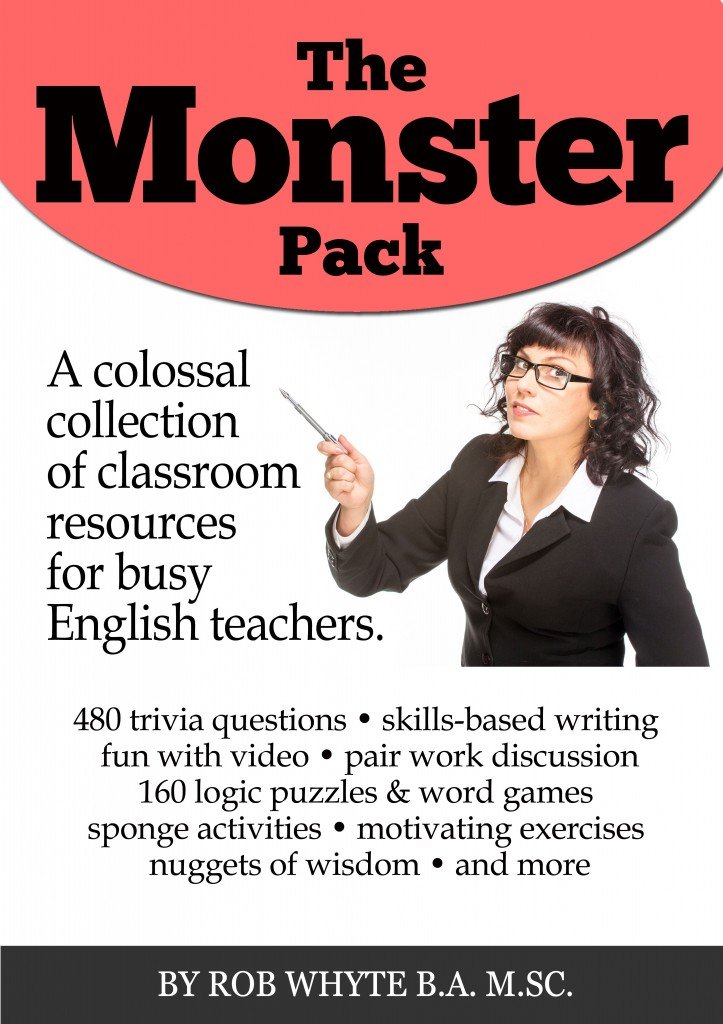
The Monster Pack comes with heaps of ready-to-go activities that help students develop and practice multiple language skills.
Buy the ebook and get great ideas to get the kids thinking, talking and moving around the classroom.
Step 3: Guided Writing (20 minutes)
Ask students to begin drafting their own poems. Provide prompts for each line:
- Line 2: “Think of four adjectives. Look at the board for ideas.”
- Line 3: “Write about someone important to you: mother, father, friend, teacher.”
- Line 4: “What do you love doing? Sports, hobbies, activities?”
- Line 5: “What are you afraid of? Animals, situations, objects?”
- Line 6: “What do you want to do or see in the future?”
- Line 7: “Where do you live? City, country, or even ‘Earth.’”
Circulate around the room to support vocabulary choices. Encourage creativity but remind students to keep sentences short and clear.
Step 4: Practice Reading Aloud (10 minutes)
Once poems are drafted, ask students to practice reading them aloud quietly to themselves or with a partner. Emphasize pronunciation, rhythm, and confidence. Model expressive reading by performing your own poem with energy.
Step 5: Talking Poem Activity (20 minutes)
Now comes the dynamic part. Ask students to stand up with their poems. Explain the rules:
- Walk around the classroom.
- When you meet a classmate, stop and read your poem aloud.
- Listen to your partner’s poem.
- After both have shared, move on to find another partner.
Encourage students to meet at least five different classmates. The repetition helps them gain fluency, while the movement keeps energy high.
Optional variation: After reading, students can ask one follow‑up question, such as “Why do you want to visit China?” or “Why are you afraid of bees?” This adds conversational practice.
Step 6: Reflection and Debrief (15 minutes)
Bring the class back together. Ask:
- How did it feel to read your poem aloud?
- What new words did you learn?
- What did you discover about your classmates?
Highlight the importance of structure: because everyone followed the same format, communication was easier and more predictable. Stress that predictability builds confidence in speaking.
Teacher Tips
- Scaffold vocabulary: Provide word banks for adjectives, hobbies, fears, and wishes.
- Model enthusiasm: Your own poem should be lively; students mirror your energy.
- Encourage movement: The walking element is crucial. It breaks monotony and reduces anxiety.
- Adapt difficulty: For beginners, allow shorter phrases. For advanced learners, encourage more descriptive adjectives or complex wishes.
- Celebrate diversity: Poems reveal personal stories. Use this as a chance to build empathy and classroom community.
Extensions
- Creative Writing: Ask students to write a “Talking Poem” about a famous person or fictional character.
- Art Integration: Have students decorate their poems with drawings or symbols.
- Performance: Organize a “Poetry Circle” where students perform their poems dramatically.
- Grammar Focus: Use the poems to highlight sentence structures (e.g., adjective order, verb forms).
Conclusion
The Talking Poem is more than a writing exercise; it is a structured, movement‑based speaking activity that energizes the classroom. By combining predictable language frames with personal expression, it allows ESL learners to practice fluency without fear. The walking element transforms the activity into a social event, encouraging students to connect with multiple peers. Teachers who adopt this activity will find that it not only strengthens speaking skills but also builds a supportive, lively classroom community.